May 30, 2007

Lilly Conferences on Teaching and Learning

Lilly Conferences are annual retreats that combine workshops, discussion sessions, and major addresses with many opportunities for informal discussion about excellence in college and unversity teaching and learning. Internationally-known scholars join new and experienced faculty members and administrators from all over the world to discuss topics such as gender differences in learning, incorporating technology into teaching, encouraging critical thinking, using teaching and student portfolios, implementing group learning, and evaluating teaching.

The Lilly Conferences are held at national and international levels. The nearest 2007 National Conference is in Traverse City, Michigan from October 4th until 7th. The 2007 International Lilly Conference will be held at Miami University in Oxford, Ohio from November 15th to 18th.

To be a presenter or copresenter at the Lilly Conferences, submission of a proposal and registration is required. For the International Lilly Conference the proposal must be submitted by June 15, 2007 and the early bird registration deadline is October 1, 2007. For Traverse City, poster presentation proposals are being accepted until September 5th and early registration rates are available through July 11th.

For more information on the conferences go to
http://www.lillyconferences.org/

How would attending a Lilly Conference help someone improve their teaching methods? What are some of your experiences at this or other teaching conferences?
Click on the COMMENTS link below to get started!


May 25, 2007

Learning and Teaching in Second Life


The Center would like to thank Anthony Fontana and the wide range of faculty and staff who attended our first Second Life workshop. The workshop focused on the teaching and learning possibilities in the online virtual world called Second Life. The enthusiasm and questions generated will provide momentum as the University continues to explore the possibilities of Second Life as a environment for learning.

Over 20 interested BGSU community members attended yesterday's discussion, sharing both possibilities and concerns associated with using a virtual environment in the classroom. The Center is offering "open lab" times today from 10-12pm and 2-4pm; additionally we encourage anyone to make an appointment for a one-on-one Second Life consultation. The Center is currently planning additional SL workshops, discussions and "open lab" times for the summer and fall semesters.


In case you missed yesterday's event, here are some of the highlights:
  • The artistic and community aspects of Second Life were briefly discussed.
  • Existing educational endeavors in Second Life were explored.
  • Issues with research in Second Life were considered and discussed at length.
  • The BGSU "island" in Second Life was revealed, and the possibilities surrounding its use by the BGSU community of educators and students was explored.

Workshop times include:
* Open Lab, Friday, May 25th, 10 a.m. - 12 p.m.
* Open Lab, Friday, May 25th, 2 p.m. - 4 p.m.


For those who attended the seminar, what are the most promising educational uses for Second Life? What concerns or suggestions do you have regarding Second Life? Do you have any helpful tips or experiences to share with other people that have just started exploring the "Wild West" a.k.a. Second Life?
Click on the COMMENTS link below to get started!


May 23, 2007

Ask AL- Tech Tip Filtering a Datbase using Check Boxes

How can I filter my database entries when I use check boxes?

AL's answer for Mac using FileMaker Pro
http://www.atomiclearning.com/almovie?key=28796

AL's answer for PC using Access
http://www.atomiclearning.com/almovie?key=27285


Would this tip help you organize your database better? Do you have any other databasing tips to share? If you try this, tell us about your success or problems implementing this technique...Click on the COMMENTS link below to get started!


May 21, 2007

Learning Community Celebration Dinner & Accomplishments 2006-2007

The following is a brief overview of the accomplishments that were shared during the Learning Community Celebration Dinner, hosted by the Center and the Office of the Provost on May 3rd, 2007. This year, 164 faculty, graduate students, and administrative staff participated in 12 learning communities. The Center thanks all facilitators, participants, and the Office of the Provost for their continued dedication to and support of learning communities as a means for transformative professional development.


Active Learning in the Natural Sciences
Discussing, designing, implementing, and adapting new interactive engagement learning strategies for the large enrollment and/or introductory level science course

Grant Writing
Engaging in extensive peer review of members’ grant proposals, resulting in revision and development and submitting four federal-level grant proposals and several state and local grant proposals

Initiatives for the Future (IF)
Integrating futures thinking exercises into twelve courses, Office for Educational Outreach catalog, and BEST Partnership Customized Training catalog, while creating a visioning strategy for the “Shaping the Future of the Firelands,” community revitalization project

Life Science Scientific Teaching and Reform
Discussing, designing, implementing, adapting, and presenting new, interactive learning strategies focused on teaching reforms and teaching scientifically

Mentoring & ePortolio
Developing mentoring skills and strategies, including team and peer models through the creation of electronic identities and the implementation of professional development plans throughout the academic year

New Faculty
Sharing, discussing, and applying focused pedagogical strategies that can transform student engagement and learning; exploring university learning resources available for students and faculty such as the Writing Center, Chapman Residential Learning Community, IDEAL, scholarly communication, and teaching portfolios

Pedagogies in the Arts and Humanities
Researching and planning the Arts Pedagogy course to be offered summer 2007 to BGSU graduate students and sharing strategies for teaching non-arts majors in the various disciplines

Publication
Fostering interdisciplinary collegiality through reading, discussing, critiquing, editing and revising faculty members' conference presentations and essays in-progress

Reflective Teaching
Reflecting on teaching and students’ learning through collaborative problem-solving—culminating in the development of new activities, assignments, and teaching portfolios

Research and Teaching
Engaging in discussions about research and writing goals and the challenges inherent in research and teaching, including group authorship of a manuscript on "The Ripple Effect," submitted to the peer-reviewed Journal on Excellence in College Teaching

Research in Science & Mathematics Education
Engaging in critical discussions of research about how people learn and presenting STEM education research, leading to the creation of collaborative research paper presentations, publications, grant proposals, and a spin-off seminar on research and statistics in STEM education

Transition to Digital
Gaining an awareness of BGSU technology resources, increasing knowledge and experience using various tools to actively engage students inside and outside the classroom; developing a collaborative, peer-reviewed conference presentation on technology-related learning communities

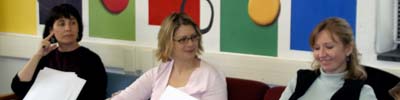
This year's faciliators (L to R): Jodi Haney, Karen Sirum, Mary Natvig, Andrew Hershberger, Mark Earley, Kay Strong, Lara Martin Lengel, Amy Robinson (not pictured: Kris Blair, Paul Cesarini, Radhika Gajjala)


For more information on this past year's learning communities, visit The Center's CTLT Learning Communities webpage. Applications for new learning communities will be available here for download in June.

May 10, 2007

New Workshop: Second Life

Learning and Teaching in Second Life

This workshop and series of related “open lab” times are presented by the Center as a means of introducing attendees to the possibilities of Second Life as they pertain to the classroom.

The workshop will consist of two distinct phases – the “official” workshop, presented by guest speaker Anthony Fontana, and the “open lab” times, where Center staff will be available to assist you in more personal and direct explorations of the environment of Second Life.

Attendees will be introduced to various pedagogical tools and resources as related to Second Life – as well as guided through the practical steps of creating a free account, using the interface, and finally exploring resources located entirely within Second Life.

Second Life is a popular persistent online virtual “world” where users from around the globe can explore digital environments and interact with other users. More and more institutions of higher education are using Second Life to create unique virtual learning experiences. The technologies powering Second Life are similar to those that power various popular computer games, but are directed to a purpose more in line with so-called “Web 2.0” applications – essentially focusing on communities of users and user-generated content within the virtual spaces. Second Life has currently surpassed six million registered users, and has in excess of forty thousand users logged in at any given time.

Workshop times include:

* Anthony Fontana - Presentation on Second Life, Thursday, May 24th, 3 p.m. - 5 p.m.
* Open Lab, Thursday, May 24th, 10 a.m. - 12 p.m.
* Open Lab, Friday, May 25th, 10 a.m. - 12 p.m.
* Open Lab, Friday, May 25th, 2 p.m. - 4 p.m.

To register for these workshops visit our CTLT Workshop page and sign-up.


Have you ever used Second Life before? If so, how? What positive possibilities could online interactive classes create in the future?
Click on the COMMENTS link below to get started!


May 8, 2007

Summer Reading List & CTLT Lending Library

If you're looking for a good book or two to read this summer, below is a small sampling of "best bets" from our CTLT lending library.

For a full listing of titles, visit our CTLT Lending Library Webpage. Most titles can be checked out for 2-4 weeks, so give us a call (2-6898)/ email (ctlt@bgsu.edu) to make reservations or just stop in and browse the offerings.

If you have additional selections of interest or suggestions for other faculty or graduate students, please leave them in the COMMENTS area below this posting!


TEACHING & LEARNING
  • What the Best College Teachers Do by Ken Bain
  • Learner-Centered Teaching: Five Key Changes to Practice by Maryellen Weimer
  • Creating Significant Learning Experiences: An Integrated Approach to Designing College Courses by L. Dee Fink
  • The Joy of Teaching: A Practical Guide for New College Instructors by Peter Filene
  • Mckeachie's Teaching Tips: Strategies, Research And Theory for College And University Teachers (College Teaching) by Wilbert James McKeachie
  • First-Order Principles for College Teachers: Ten Basic Ways to Improve the Teaching Process by Robert Boice
  • Teaching with Your Mouth Shut by Donald L. Finkel
  • How People Learn: Brain, Mind, Experience, and School: Expanded Edition by National Research Council
  • My Freshman Year: What a Professor Learned by Becoming a Student by Rebekah Nathan

NEW FACULTY
  • Faculty in New Jobs: A Guide to Settling In, Becoming Established, and Building Institutional Support by Robert J. Menges
  • Mckeachie's Teaching Tips: Strategies, Research And Theory for College And University Teachers (College Teaching) by Wilbert James McKeachie

TECHNOLOGY/FUTURE ISSUES
  • Teaching Online: A Practical Guide by Susan Schor Ko and Steve Rossen
  • A Whole New Mind: Why Right-Brainers Will Rule the Future by Daniel Pink
  • The Long Tail: Why the Future of Business Is Selling Less of More by Chris Anderson

FACULTY-RELATED FICTION
  • The Missing Professor: An Academic Mystery / Informal Case Studies / Discussion Stories for Faculty Development, New Faculty Orientation and Campus Conversations by Thomas B. Jones

PUBLISHING/SCHOLARSHIP
  • Publish and Flourish: Become a Prolific Scholar by Tara Gray


Share some of your favorite teaching, learning, or faculty-related books by clicking on the COMMENTS link below to get started!


May 7, 2007

BGSU MyFiles Announcement


BGSU has unveiled a new service for Faculty, Staff, and Students...


MyFiles is a network-based, file storage system. It can be accessed at MyFiles.BGSU.edu, simply login using your BGNet Username and password. MyFiles provides 1 Gigabyte of disk space per person and allows an individual to store copies of important documents such as homework, notes, papers, and graphics on a system that is accessible from anywhere on the Internet.

What is MyFiles?

Files stored on MyFiles can be accessed from any computer connected to the Internet through a web browser such as Internet Explorer, Mozilla Firefox or Safari.

Files stored on MyFiles can be shared with friends, colleagues, collaborators, project team members, and others, both on and off campus. File owners are able to provide access that can be read-only or read-write, allowing for controlled access and collaborative editing.

Files stored on MyFiles can be tracked to see who has read the file and who has made changes to the file. MyFiles can even store multiple versions of a file to keep a history of revisions.

Files stored on MyFiles are secured by BGSU authentication username and password, and can be accessed by others only if the account owner gives permission. Access can be assigned based on BGSU usernames and passwords, or by electronic ticket that allows individuals not associated with BGSU to gain read-only or read-write access.

Files stored on MyFiles can be accessed by clicking on a designated web URL. Each file has a specific web URL that can be sent to others through email instead of sending entire files as attachments.


What MyFiles is NOT:

Not a place for instructors to store class notes, Blackboard should be used for this.

Not a place to share the latest ripped version of your favorite CD. Please remember that all use of BGSU's network and systems must comply with all BGSU network usage policies and all copyright laws. Violations may result in your MyFiles privileges being suspended, and you may be referred to appropriate authorities.


How could you as a faculty member utilize MyFiles? How could your students use the service? Click on the COMMENTS link below to get started!


April 17, 2007

What Web 2.0 Can Teach Us About Learning


The Chronicle article "What Web 2.0 Can Teach Us About Learning" is an interesting article looking at the use of course management systems and Web 2.0 tools in the classroom. Edward Maloney explains that most course management systems (BlackBoard and WebCT) have been utilized as a means to disperse media and not as an interactive teaching tool. The article provides some insights into the future uses of Web 2.0 in the classroom.


• How have you used Web 2.0 Tools to teach online or in a face to face (F2F) classroom?
• What are some limitations of course-management software (BlackBoard)?
• What works well for your students? What have they said?
• Click on the COMMENTS link below to get started!


April 16, 2007

Creative Commons License


Copyright, author's rights, and licensing of personal works continue to enter into discussions at all levels of university work. From faculty authorship to students' creative works available on the Internet, each individual can now specify the conditions for the distribution and use of their works using the Creative Commons.

[From the Creative Commons website:]

What You Can Do Here

Creative Commons helps you publish your work online while letting others know exactly what they can and can't do with your work. When you choose a license, we provide you with tools and tutorials that let you add license information to your own site, or to one of several free hosting services that have incorporated Creative Commons.

With a Creative Commons license, you keep your copyright but allow people to copy and distribute your work provided they give you credit — and only on the conditions you specify here. For those new to Creative Commons licensing, we've prepared a list of things to think about. If you want to offer your work with no conditions, choose the public domain.


For more information:
• Here's an example of a Limited Use License icon that can be placed on your webpage or within the digital work itself:
Creative Commons License -- This work is licensed under a Creative Commons Attribution-Noncommercial-Share Alike 2.5 License.

Generate a Creative Commons License

Choosing a License

Types of Creative Commons' Licenses


• How could the Creative Commons be used in your work?
• Why might students want to be aware of this resource? Click on the COMMENTS link below to get started!


April 5, 2007

New Models of Publishing (Workshop Extension)


On March 15th, the Center and the University Libraries collaborated to offer part two of the Information Transformation Discussion Series, New Models of Publishing.

Here are some of the discussion items from this session:
We get tenure based on what we disseminate as a scholar – the number of times your work has been cited is a critical measure; should reviewers of tenure include how often a website is cited? A blog? Since there is no standard format for online writing/publishing (APA, etc.), does that make it less accurate or important?

In some ways, scholars are terrified about what they put on the web or to open access.

This is a whole new way to look at or reconceptualize how we are considered as academics in the field.

We teach graduate students about APA during their first course/class, but don’t mention anything about online publishing options.

“Digital Scholarship” – moves beyond PDF files to also include multimedia such as audio, video, and flash animations (using Adobe Acrobat Professional).

What about peer-reviewed podcasts & YouTube video submissions – still need text; need to train peer reviewers as well.

We’re still in the habit of teaching writing in schools, but not multimedia skills to represent concepts and knowledge – why not? Oral histories or ethnographies are a great example of reasons to use mulitmedia – capture with video/audio: singing, dancing, emotion, intonation, etc.

Is there something wrong with scholarly activities and creations being fun? (video, audio, multimedia, etc.)

This emphasizes the importance of media/information/digital literacy for students (and faculty) – who will teach this?

Web Resources:

Brief Overview of Open Access

Detailed Overview of Open Access

SPARC - Scholarly Publishing and Academic Resources Coalition
For more information on:
• Author Rights; including the Author's Addendum to submit with your publication agreements
• Journal Pricing
• Open Access
• Open Data
• Public Access to Research
• Repositories

Create Change.org who asks, "Shouldn't the way we share research be as advanced as the Internet?"
• This website will help you understand the changing landscape and how it affects you and your research. It also offers practical ways to look out for your own interests as a researcher.
• A scholarly revolution is underway. It enables you to get a greater return from your research. All you have to do is share it.

DOAJ – Directory of Open Access Journals


The third and final discussion, New Models of Owning Ideas will be held on Tuesday, April 17th from 12-1:15 in the Pallister Room at Jerome Library. Here is the description:
New models of publishing provide choices for authors. What are the advantages and disadvantages of new models of owning ideas? Does the author keep the copyright, retain some rights through Creative Commons, give the copyright to the publisher? Join this discussion to learn about these options and think about what is the best choice for you.
To register, contact the Center at 372-6898, ctlt@bgsu.edu, or use the online form.

Learning Communities Update - April 2007

The 12 CTLT learning communities are winding down the academic year with their last meetings and events. This year, over 170 BGSU faculty (from Main & Firelands campuses), graduate students, and staff participated in a variety of professional development activities. Their accomplishments and successes will be highlighted at the Learning Community Celebration Dinner held May 3 in BTSU.

For more information about the current learning communities offered through the Center, visit our Learning Community webpage or contact the Center for more information (2-6898 or ctlt@bgsu.edu).

Applications for next academic year's learning communities will be available in June. Watch this site or the CTLT website for more information.